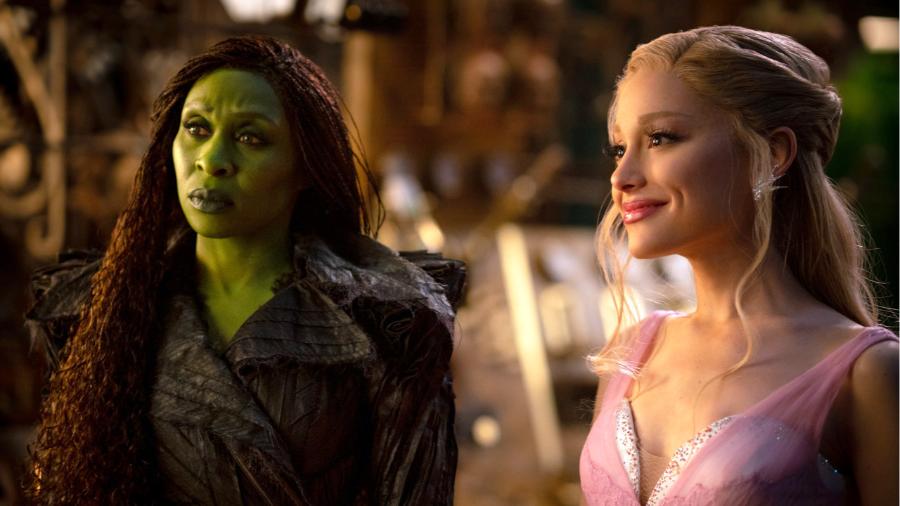
“The wand really sells it.”
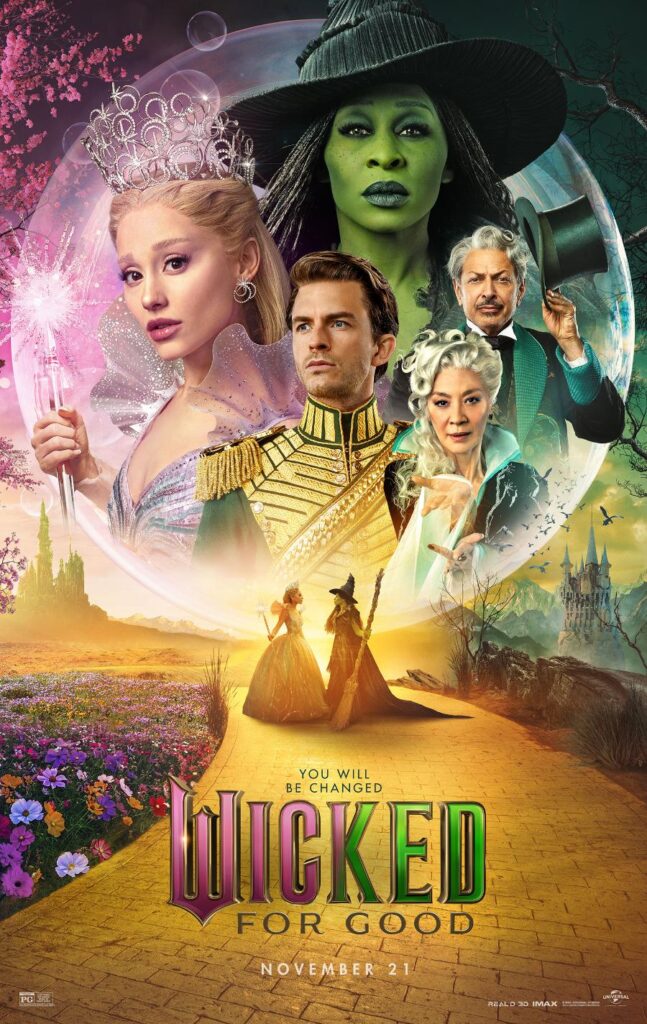
Overwrought and overlong, Wicked: For Good, the sequel to 2024’s award-winning Wicked, is an ambitious film that fails to meet the high bar its predecessor set despite incredible musical performances and stunning set-pieces. The film also contains an underlying, timely, deadly serious message about authoritarianism and the pernicious nature of propaganda that unfortunately gets buried under five thousand tons of pink cotton candy fluff.
“If it makes you happy, of course I’ll marry you.”
Wicked: For Good is a 2025 Universal Pictures production directed by Jon M. Chu from a screenplay by Dana Fox and Winnie Holzman that draws heavily from both the Broadway musical Wicked and the 1995 book, Wicked: The Life and Times of the Wicked Witch of the West by Gregory Maguire. Stars Cynthia Erivo and Ariana Grande lead an ensemble cast including Jeff Goldblum, Michelle Yeoh, Ethan Slater, Marissa Bode, and Jonathan Bailey, along with Colman Domingo, Bethany Weaver and Bowen Yang.
“Well we all can’t come and go in a bubble.”
It is the fifth year of the Wizard (Goldblum), and the Emerald City is spreading its influence to every corner of the realm. Goaded by the lash of cruel taskmasters, enslaved woolly rhinos are laying down the yellow bricks of the soon-to-be-famous road. Cackling like a deranged comet, Elphaba (Erivo) darts in from above and sets the beasts free before snapping the whips back at the panicked and retreating guards.
Meanwhile, in the heart of the Emerald City, after brushing off Glinda’s (Grande) sycophants, Madame Morrible (Yeoh), the Wizard’s Majordomo, gets her ready for the Big Con. As the centerpiece of the Wizard’s “Wicked Witch” propaganda efforts and counterbalance as the Good Witch, she must look the part to play the role. Morrible provides her with a sparkly wand and a pearlescent, pink bubble-mobile to whisk her to and from through the air, like a proper witch. She is also to marry her former classmate and crush, Gale Force Captain Fiyero (Bailey), who will wed Glinda if it would please her, but would much rather be with Elphaba, who is unfortunately, Public Enemy #1, the “Wicked Witch of the West”.
Elphaba’s sister, Nessa (Bode) is now the well-established Governor of Munchkinland. Having helped stabilize her situation, Boq (Slater) wants to head to Emerald City and follow his heart as he is smitten with Glinda and has longed for her love since they were students together. This does not sit well with Nessa, who locks down the borders of Munchkinland and has her internal security demanding travel papers from any who wish to exit the territory to the extent that her goons are yanking citizens off passenger trains for lack of proper documents. This thwarts Boq’s departure plans, and knowing where these orders came from, he is forced to return to Nessa.
Maudlin for the past, Elphaba decides to visit Munchkinland and Nessa. There she faces her sister’s wrath as Nessa is incensed that Elphaba missed their father’s funeral and furious that she had never used her magic to fix Nessa’s paralyzed legs. Relenting, Elphaba reaches for the grimoire and channels the energies to enchant Nessa’s silver footwear, which flash ruby red as the woman begins to tentatively fly into the air above her desk. Seeing this, Boq rejects Nessa’s pleas to stay and resolves to redouble his effort to find romance in the Emerald City.
Panicking, Nessa snatches the grimoire and searches for a spell that will keep Boq from following his heart. However, the untrained Governor botches the incantation, leaving Boq slumping in agony, forcing Elphaba to shoo her sister away and spring into action.
When an exhausted Elphaba emerges, she tells her sister to piss off and leave Boq alone, who is sleeping after his ordeal. Summoning her broomstick, the “Wicked Witch” soars to the Capitol, having determined that, as it was her fault that the Flying Monkeys grew wings in the first place and were enslaved by the Wizard, she is responsible and has to set them free. Sneaking into the Wizard’s steampunk lair, a brass maze of levers, pipes, and gears, Elphaba is confronted by Glinda and the Wizard, who implore her to abandon her anarchistic struggle and join them by way of the show-stopping musical number, Wonderful.
Will the Wizard manipulate yet another person to get his way? Can Elphaba stay true to herself? Will she resist reconciliation with her lost bestie? Can Glinda realize she’s been a dupe in time? See Wicked: For Good for answers.
“They’ll never stop believing in me because they don’t want to.”
Like the recent remake of The Running Man, Wicked: For Good has real-world concerns and political issues concealed in a sabot. However, unlike the Edgar Wright movie, that message doesn’t penetrate through the length of the film and gets buried in the fluff maybe a third of the way in. The baleful power of propaganda to lull the masses into blind obeisance and push authoritarianism is vividly depicted in the opening reels. Elphaba is turned into a caricature, a fictional villain, an Emmanuel Goldstein, a focus of the Two-Minute Hate from George Orwell’s prescient 1949 masterpiece, 1984. The scenes of Munchkins being pulled off of passenger trains are paralleled in recent experiences with ICE and CBP across America, and the enraged mob on the march while screaming for the Wicked Witch’s head reflects other recent MAGA phenomenon that might come to mind. Then the movie gets distracted by the twists and turns of the soap opera and loses track of the underlying messages. In fairness, Wicked: For Good is a spectacle, a hallucinogenic, musical roller coaster so it’s understandable how Chu could be distracted.
The moody, Scooby-Squad group of protagonists have the vibe of a dysfunctional, possessive polycule unable to share or communicate. Every character wants to hook up with someone who has another on their minds and they’re very growly about it. There is a very clear contrast between the two main characters. Elphaba, the woman who stayed true to her principles has been granted eldritch power by the grimoire and flies into action like the wind of vengeance while in the heart of the glamorous Emerald City, absorbing adulation from her fans, Glinda is revealed to be a complete and utter fraud. Her wand is a sparkly fake and her bubble-mobile a gift from the real power hiding behind the scenes.
The grimoire seems to act like the monkey’s paw depicted in The Monkey’s Paw: A Retelling from the 1965 episode of the Alfred Hitchcock Hour in that all the magic Elphaba initially entices from the tome turns foul, and those she optimistically enchants all run hard aground on the seas of fate.
Goldblum is great in his limited screen time. There’s some of the Grandmaster in his portrayal of the weaselly Wizard, but at a crucial moment, this character feels what the Grandmaster isn’t capable of, a deep shame for his despicable deeds that prompts his departure.
Yeoh’s Morrible doesn’t have much of a discernible motivation to do any of the monstrous things she does in this movie, and a decision she makes in the last reel is baffling, to say the least.
The focus is on Glinda as she carries the growth of her character through her pride via introspection to the point where she realizes that she’s been played, she’s the baddie, and has made the wrong call from the start due to her arrogance and jealousy. Grande depicts this transition well, though most of her transformation comes in the form of musical exposition.
Elphaba does have an arc in the film, though it’s a short one with an abrupt reversal. Though she’s depicted as clever, competent and tactically brilliant throughout the film, there is one area in which she comes up wanting; at first she’s a hapless magic user hoping her spells won’t go wrong, then heel-turns and becomes a malevolent mistress of the mystic arts who then does a face-turn in the last reel and renounces her power, granting her grimoire to Glinda, who can finally learn to become a Good Witch.
There is a moment about three-quarters into the movie where this reviewer was lurched from his suspension of disbelief: A moment where, standing in front of the famous farmhouse from Kansas and the crushed corpse of their sister and friend, the two main characters get into a ridiculous slap-fight that goes on SO long and gets SO silly.
The sequencing and continuity is a bit wonky in Wicked: For Good. An effect akin to the Game of Thrones travel-time-trope becomes very noticeable towards the end of the film. Setting out at the same moment and forsaking her bubble-mobile, Glinda gets to Elphaba’s Winkie castle on horseback well before the mob led by the Lion, the Scarecrow and the Tin Woodsman departs the Emerald City. It contributes to a sense that the film is poorly paced. Wicked: For Good is framed in a flashback device that closes the picture, while containing within the depicted story flashback sequences within flashback sequences. This lavish, lush, extravagant, Rococo love story runs maybe 20 minutes too long.
Wicked: For Good shows great respect to Judy Garland’s Dorothy Gale by never showing Weaver’s face throughout the runtime. The other characters from the 1939 film aren’t given such deference, and some are twisted beyond recognition in the book Wicked, the musical, and the feature film. The Woodsman, in particular, is distorted from a sensitive, loving dreamer into a deranged, enraged stalker filled with lie-fueled hate for the woman who saved his life. His “Here’s Johnny!” moment lifted right out of Kubrick’s The Shining feels wrong and out of place.
Wicked: For Good is stretched thin and overstuffed at the same time. The musical numbers are great and splendid shows, but it’s between them where Wicked: For Good trips. Too much and not enough at the same time, the story would’ve been better served had the Broadway show not been split into two films. See Wicked: For Good in the theatres if you’re in a rush to catch the sequel; otherwise, wait for streaming so you can pause for pee-breaks.
Wicked: For Good is in theatres 11/21/2025.
 Newsdesk