
Anthony Andujar Jr. of Fanboy Factor conducted an interview with editors Mohammad Saba’aneh and Annabelle Heckler about their recent publication, *World War 3 Illustrated: The Right to Live in Peace*, from AK Press. Following their initial meeting at The Printed Matters Book Fair on September 12, 2025, with previous interviewee Carlo Quispe, it was essential to hold this interview. We extend our sincere thanks to Carlo Quispe for facilitating this important discussion. We also express our gratitude to Annabelle Heckler and Mohammad Saba’aneh for taking the time to engage in conversation and for highlighting the challenges faced by those in need during catastrophic times.
Interviewee: Annabelle Heckler and Mohammad Saba’aneh
Interviewer: Anthony Andujar Jr
Q1 World War 3 Illustrated has been published since the 1970s and is recognized as one of the earliest comic publications that addressed social issues and the challenges facing communities. The current issue continues this tradition, but with a unique focus: it is dedicated to comic creators from Palestine. How did this project come about?
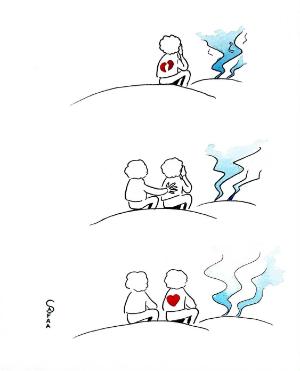
Annabelle: World War 3 Illustrated Collective first published an interview with Palestinian artist Naji Al-Ali in 1988. Since then, members of our collective have worked in solidarity with artists in Palestine, and we have regularly run pieces that expose the oppression of the Palestinian people.
Over the last two years, we heard from Palestinian artists who want to get the word out about what is happening in Gaza, so we devote our new issue to The Right to Live in Peace, in the words of Victor Jara’s iconic resistance anthem.
Q2 As an editor, how did your love for comics and the various genres within the medium inform your approach to editing?
Mohammad: We asked artists to bring their resistance and their vision to our pages. As Edward Said said, “The power to narrate, or to block other narratives from forming and emerging, is very important to culture and imperialism, and constitutes one of the main connections between them.”
Q3 In today’s media and comic book landscape, there appears to be significant censorship from fandoms and corporations regarding creators speaking out on world issues. As an editor, how do you navigate guidelines with creators to foster a healthy environment that encourages productive dialogue? How can you ensure that creators have a safe space to express themselves in an era marked by fearmongering and censorship from those who prefer to promote hate speech rather than freedom of speech?
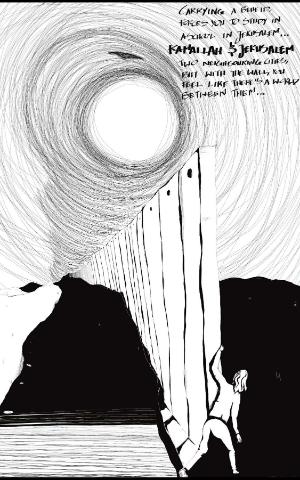
Annabelle: We are a volunteer collective of political activists and artists based in New York City and providing a home for comics from around the world, published by AK Press, supported by readers like you. We seek out artists who are anti-racist, anti-militarist, and anti-capitalist, and invite them to express their own point of view, drawing comics that express humane values and think deeply about their subject material. In this issue, you will find many different voices, first-timers and established professionals, all opposed to the genocide in Gaza.
Q4 How did you, as an editor and as creators, navigate communication between all the artists that submitted work to the zine? What was the process of finding artists? Was it through scouting? Word of mouth? Did artists initiate contact? How did you navigate getting as many creators in The Right to Live in Peace?
Annabelle: As our contributor Samir Harb put it, “Thank you, Mohammad [Saba’aneh], for your extraordinary efforts in bringing us together and setting up a connection.”
Mohammad: Communication was challenging for several reasons. The time difference between the United States and Palestine—and metaphorically speaking, between Mohammad in the West Bank and artists in Gaza—posed a challenge, especially amid frequent communication blackouts and the inherent dangers involved. Communications between the West Bank and Gaza are monitored, and since he lives under direct occupation, he could easily be arrested on suspicion of contacting groups inside Gaza.
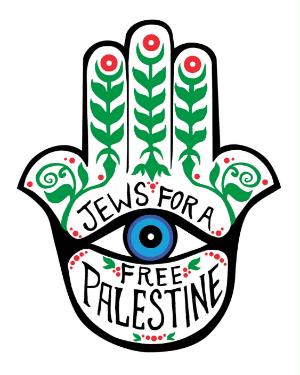
Persisting to amplify Palestinian voices is crucial and worth the effort.
Q5 Were there any barriers to entry when getting a hold of artists’ contributions? How did artists work around such conditions?
Annabelle: What is it like to draw under an occupation? The Right to Live in Peace includes work by Palestinian artists like Safaa Awad, Sohail Salem and Hamza Abu Ayyash, often available for the first time in the U.S., in English, many on-the-ground, drawings and diaries in graphic form, eyewitness accounts of the ongoing destruction and death, and personal visions that make the horrors, and the glimmers of hope and solidarity, come to life. Sohail Salem draws in pen in an UNRWA notebook.
Mohammad: Safaa Awad, a Palestinian artist from Gaza, shares her illustrated testimony in several newspapers, most notably Qatar’s Al-Araby Al-Jadeed. Like countless Palestinians in Gaza, she was forcibly displaced from her home, reduced to rubble by Israeli bombardment. Moving from shelter to shelter, she found refuge in her artwork from the devastating airstrikes and the ongoing genocide against Palestinians.
Q6 As you compiled this issue, going in, was there a specific idea in mind for how this issue was to be made? Was it more about covering the stories specifically tied to the genocide, or did creators have the freedom to contribute or create whatever story they wanted that they felt they had to give?
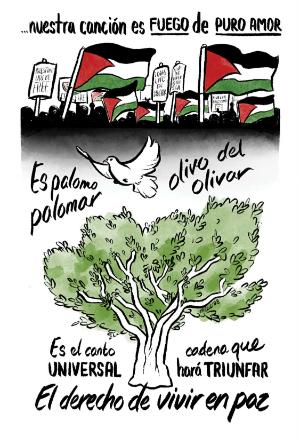
Mohammad: Palestine, as a bold headline, encompasses countless stories that must be told. Indeed, any topic touching on Palestine inevitably leans toward highlighting what Palestinians endure—whether the overt genocide in Gaza or the silent, ongoing erasure in the West Bank and within Israeli prisons. Yet, more importantly, it is essential to present Palestinian voices exactly as they wish to convey them. Palestinian artists have powerfully demonstrated their ability to represent their own struggles and narratives.
International solidarity—from artists around the world— sends a clear message to Palestinians: the peoples of the world stand with them.
Q7 As an editor, what was the most challenging part of making this issue? And what do you feel makes World War 3 Illustrated so impactful?
Annabelle: Our artists in Palestine draw every day against displacement, genocide, and erasure, draw to free close family members from Israeli prisons and Palestinian jails. Mohammed notes: We as Palestinians are human beings. We have artists, we have writers, we have this opportunity to create visual art that conveys our narrative for the reader and the audience from around the world.
For artists who are “más allá del ancho mar,” beyond the wide sea, in Victor Jara’s words, we draw our love, heartbreak, solidarity, and rage with our fellow artists in Palestine.
Q8 Will there be more issues akin to this that shine more of a spotlight on these creators and the conditions that they face and overcome?
Annabelle: Yes! Stay tuned, we’re excited to announce our next issue soon.
Q9 This work aims to become a significant historical document that reflects the lives of people today. It highlights Palestinian comic creators who use their art to express their voices and experiences. What do you hope this entry will achieve for the contributors? Where can readers find their work to continue sharing their stories?
Mohammed: Yes, and in our long journey to liberate our land, we fight not only to free our soil, but to liberate our narrative from hegemony, oppression, and attempts at silencing. For this reason, we strive through these publications and books to convey the Palestinian narrative to the world.
Annabelle: Thank you. Please check out Mohammad Saba’aneh’s first graphic novel, Power Born of Dreams, from Street Noise Books. Follow all our artists, especially our Palestinian creators, on Instagram!
@shahdalshamaly
@safaa.art
@comics.n.coffee
@fuad_alymani
@hassanmanasrah
@amalnakhalaa
@barrackrima
@el.7mz
@nidalelkhairy
@wahaj_bani_moufleh
@maisarart
@sohail.salem
@jencamperdammit
@el_dante_aguilera
@marshmallorca
@urjuen.art
@hsfonts
@nicoleschmo, @gussie_grubman
@rscamu
@sandy_jimenez_nyc
@suesimensky
@eric.drooker
@sethtobocman1988
@suecoeart
@john_vasquez_mejias
@joe_sacco.1960 & @_art.spiegelman
@Bilsabab & @danijelzezelj
@annabelleheckler, @kungernyc & Dalal
@kuperart
@mohammedsaniasiddig
@tenayanf_, @shuman_thehuman & Floyd Tangeman
@theshroomtea
@jbbrager
@worjord
 Brian Isaacs - Executive Editor / Publisher