

Have you ever wanted to be an insider during the birth of comic books—not the version we celebrate today, but the version that actually existed?
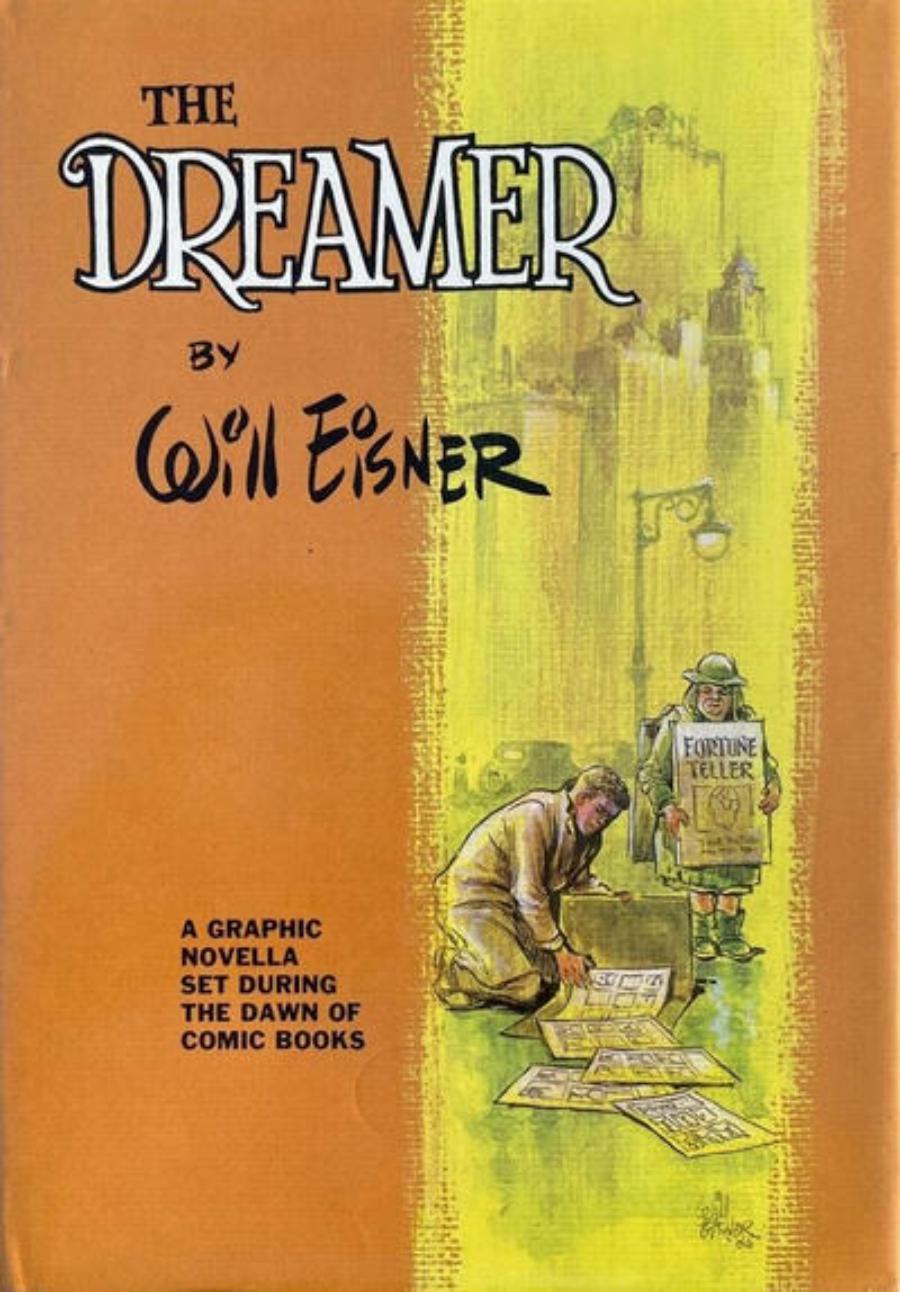
That’s what Will Eisner’s The Dreamer sets out to capture.
The Dreamer is one of Eisner’s most personal books, not because it simply recounts his early career, but because it confronts an uncomfortable truth at the heart of the comic book industry’s origins. Long before superheroes became billion-dollar brands and cultural icons, comics were a young, chaotic business built on speed, ambition, and uncertainty. It was an industry inventing itself in real time, often at the expense of the people who gave it life.
The book presents itself as fiction, but it is firmly rooted in memory. Through The Dreamer, Eisner revisits the Golden Age not as a nostalgic origin story, but as a working environment—one defined by opportunity and excitement, but also by exhaustion, imbalance, and exploitation. Young artists worked punishing hours, chased weekly deadlines, and signed contracts they barely understood, only to watch the characters they created slip out of their control almost immediately.
This story unfolds through the eyes of Billy Eyron, an idealistic cartoonist desperate to break into the world of comics. Billy dreams of success, recognition, and the simple joy of making comics for a living. In many ways, he is Eisner’s stand-in: not a literal autobiography, but a distilled version of Eisner’s early experiences, hopes, and compromises. Through Billy, we see both the thrill of creation and the slow erosion of innocence as talent collides with business realities.
As Billy moves through this world, he encounters thinly veiled versions of real figures from comics history—publishers, editors, and fellow creators recognizable as Bob Kane, Lou Fine, Jack Kirby, and others. Their names are changed, but their circumstances are unmistakable. Eisner does not portray them as villains or heroes. Instead, they are working professionals navigating an industry that has not yet decided whether it is art, business, or factory labor. Talent is abundant. Money is scarce. Ownership flows upward.
One of the book’s most revealing episodes revisits DC Comics’ lawsuit over Wonder Man, a short-lived character clearly modeled on Superman. Eisner does not frame the case as gossip or trivia, nor as a simple dispute between rivals. Instead, it becomes a warning shot—a moment that reveals how aggressively intellectual property would be protected by publishers, even as the creators themselves remained disposable. The lesson is unmistakable: the system would defend characters more fiercely than the people who made them.
This moment underscores one of The Dreamer’s central arguments. The imbalance that would define the comic book industry for decades was not accidental or misunderstood. It was established early, reinforced legally, and normalized culturally—long before creators fully grasped what they were giving up. Contracts, deadlines, and legal precedents quietly shaped the medium just as much as imagination and artistry.
What makes The Dreamer essential is not nostalgia. It is perspective.
Eisner wrote this book decades after the events it depicts, with the clarity of hindsight and the authority of someone who survived the system, succeeded within it, and still felt compelled to tell the truth. Many of Eisner’s contemporaries did not have that luxury. Some burned out. Some faded into obscurity. Some never regained control of their work. Eisner, having secured both creative independence and historical stature, was in a rare position to look back honestly—and to acknowledge the cost of success.
That honesty extends beyond economics. The Dreamer is also about disillusionment: the slow realization that passion alone does not protect creators, and that survival often requires compromise. Idealism gives way to pragmatism. Talent adapts to unfair systems. Not everyone wins, even if the industry does.
For longtime comic readers, The Dreamer offers a corrective to the sanitized myths surrounding the Golden Age. For readers familiar with Eisner, it reveals why he felt compelled to revisit this period late in life. And for those who do not read comics at all, it tells a story that extends far beyond the medium: the story of a creative industry finding its footing while leaving many of its creators behind.
The struggles modern creators face did not appear overnight. They were present at the beginning, embedded in the foundations of the industry itself. Eisner understood this, and he understood that history had become too celebratory—and too dishonest.
Eisner did not write The Dreamer to romanticize comics’ past.
He wrote it to make sure it was remembered honestly.
 Anthony Andujar Jr.