

“Maybe we’re supposed to be red sun folk and feel things.”
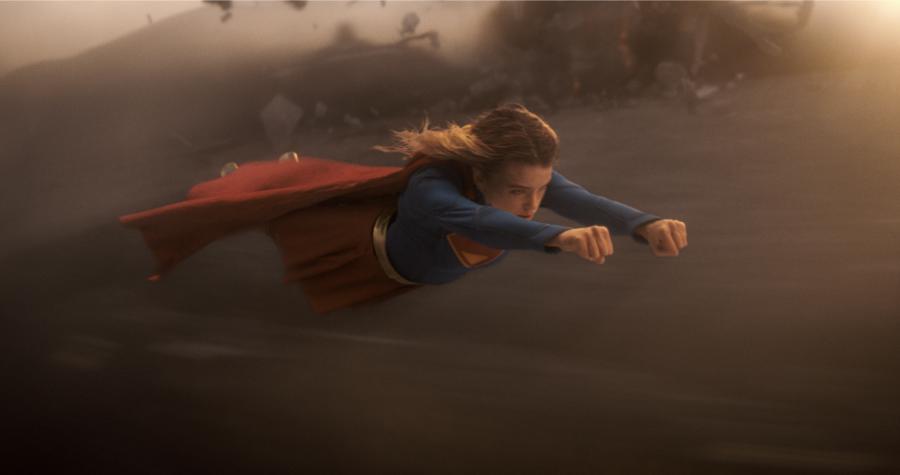
Supergirl is a saucy yet truncated adaptation that nimbly deals with weighty topics of loss, love, despair, revenge, trauma, and hope. On one level, Supergirl is about the titular character trying to stop someone from ruining their life by murdering the man who murdered her family. At the same time, Supergirl herself is working through the trauma experienced by the loss of her planet, then the collapse of her city and finally, watching her mother and father succumb to the relentless disease that devoured the entire populace. Her preferred method of coping is by burying her feelings under a vast and blustery ocean of alcohol. The confident yet bleary Milly Alcock and the dryly formal Eve Ridley make a great, Odd Couple-esque comedy duo. Jason Momoa is perfect in his bit part as the feared and ferocious bounty hunter Lobo, and he’s laughing all the way to the bank.

“Hey, could you get us closer?”
“If I had an engine and some balls, I could, but I don’t, so…no?”
Supergirl is a 2026 Warner Brothers picture directed by Craig Gillespie from a script by Ana Nogueria, which is largely an adaptation of the 2021 DC Comics miniseries, Supergirl: Woman of Tomorrow by Tom King and Bilquis Evely, itself based on the 2010 Coen Brothers film, True Grit. Milly Alcock leads an ensemble cast featuring Jason Momoa, Matthias Schoenaerts, Eve Ridley, Emily Beecham, and David Krumholtz, with an appearance by David Corenswet.
“Just be good. It doesn’t mean you can’t be tough, it doesn’t mean you have to be nice, but you MUST be good.”
Krem of the Yellow Hills (Schoenaerts), the leader of the Brigands, a band of sex-traffickers and thieves, has come to the forge of Elias Knoll, a famed swordsmith, for his handiwork. The smith offers his best blades in hopes that Krem will leave his family unharmed, but Krem kills them all anyway. Only Ruthye (Ridley) remains alive, having witnessed the murders. Seething with wrath and with a mind full of murder, the young girl grabs her father’s finest blade, intending to offer it to the person who agrees to hunt down the Brigands and uses the sword to end Krem. Her search takes her far and is fruitless.
One night, she enters a bar seeking to hire a killer of killers, but no one is interested. Worse, one of the larger aliens, uninterested in doing the work, simply takes the blade and walks off with it, ignoring her saturnine complaints. A trenchcoat-clad humanoid (Alcock) with a yappy, white dog, pushes past her and drunkenly dresses down the towering creature. A fight breaks out, and much to Ruthye’s astonishment, the girl and the dog win. The girl gives Ruthye her sword back and introduces herself as Kara Zor-El, the Supergirl and the scruffy mutt as Krypto the Superdog. Ruthye gives Kara her elevator pitch, but Kara refuses. She’s partying her way across the galaxy, hopping from one red-sun system to the next, as her Kryptonian powers are repressed by red solar rays and she can’t get drunk otherwise.
Ruthye follows Kara to her ship and asks her again the next morning. Kara doesn’t want to help Ruthye become a murderer and refuses her again. Krem has followed Ruthye, having heard that she intends to hire someone to kill him. He confronts and threatens the two girls, enraging Krypto, who leaps to his mistress’s defense. Krem shoots the dog with a poisoned dart, taking him out. A livid Kara attacks Krem, but he disengages, steals her ship, and flees.
Kara takes Krypto for medical attention, only to be told that the dog has three days left to live. The only thing that could possibly save him is the antidote to the poison that is plainly in Krem’s hands, as he’d want to be able to safely use his darts. Can Kara track down Krem before Krypto’s time is up? Will Ruthye fulfill her vow of vengeance, forever staining her soul? Will Krem of the Yellow Hills get what’s coming to him, or will he make his escape? See Supergirl to find out.
“You have all been super-useless.”
In May of 1959, Supergirl first appears in Action Comics #252. Created by Otto Binder and artist Al Plastino, Supergirl is Kara Zor-El, Superman’s cousin. Seventeen years earlier, Binder created Mary Marvel as part of a greater Marvel Family to supplement his wildly successful character, Captain Marvel, then being published by Fawcett Comics. DC wanted something similar. Whereas Mary is Captain Marvel’s sister, Kara is Kal-El’s cousin. However, they were both conceived as teen girl sidekicks with the goal of broadening readership and getting girls to buy in. Clad in costumes of very close design, both wore capes, skirts, and shirts emblazoned with the colors of their mentors.
In Supergirl’s origin, her father Zor-El manages to save their home, Argo City, from the destruction of Krypton. For a time, the space-bound citizens escape the dire fate of their surface-stuck kinsmen on Krypton, but ultimately they are doomed. The bedrock of Argo City-Satellite is rapidly transforming into Kryptonite, poisoning the populace. Zor-El and Alura come to the same conclusion his brother and sister-in-law had arrived at. They need a rocket. There’s only enough time to save Kara. They dress her in an outfit with Superman’s logo on it so he can recognize her and rocket her off to Earth, where she shares many adventures with her more famous cousin.
The movie ostensibly tells a similar story in flashback. Unfortunately, the stoic and constrained spires of Argo City are lacking the retro-futuristic, utopian, Atom-punk flourishes and flare featured in the print version, looking for all the world like 2026 Chicago.
Helen Slater stars as the maid of might in the 1984 Supergirl movie directed by Jeannot Szwarc. Subsequently, the character has also appeared in many animated films and shows as well as video games.
Supergirl features a primitive Transuit, a transparent space-suit worn by team members of the DC comic, Legion of Superheroes. Ruthye makes repeated use of the device throughout the picture. Another Easter egg from that title is the presence of the Sklarian Raiders, enemies of the Legion and a prolific group of pirates and thieves who battle Kara during a space-bus sequence. This is fitting as Kara has been an off-again/on-again member of the Legion since the Sixties.
The film is full of environments that have the same culture-shock, Creature Cantina trope from the 1977 Star Wars feature, being the unexpectedly- urbane, noisy, alien-packed, dive-bar setting. However , the film flips the meme on its head halfway through the runtime when Kara enters an establishment to find a sultry space-crooner softly singing The Girl from Ipanema in perfect English.
Kryptonite is one of the substances that can injure or kill even a fully charged Kryptonian. Introduced by the radio show in 1943, the element was soon used by every Tom, Dick, and Harry in an attempt to take Superman down a peg in the comics as well as other media. This overuse irritated writer Denny O’Neil, the man behind the 1971 story published in Superman #233, Kryptonite No More! wherein all Kryptonite was transmuted into iron after a scientific accident on DC’s Earth-1.
There is a lot of Kryptonite used in Supergirl. Way more than one would expect when there are only two Kryptonians active or alive anywhere in the Gunn-verse (as far as the audience is aware) and only one of them is wandering through space on a bender. Not to mention there’s no way for the Brigands or even Krem to know that their adversary IS a Kryptonian. Both Lobo the Czarnian and Krem himself possess great super-strength. However, the man from the Yellow Hills repeatedly attempts to hobble Kara throughout the film, owing to Krem knowing that he is considerably weaker than Supergirl.
Krem is ably played by Schoenaerts, but the character’s design is very different than what appears in print and is rather ludicrous. This incarnation has a piercing-festooned face and cheap-looking, skeletal armor. His lazily-named gang, the Brigands, completely lack a unique visual identity. This reviewer was struck by Krem’s resemblance to the character, Taserface, from Gunn’s 2017 film, Guardians of the Galaxy Vol. 2, who was also a blowhard and a bit of a joke. This character, the main antagonist, The Big Bad of the picture, is woefully underbaked and underdeveloped. It’s a problem. It’s one of the film’s few issues, but it IS a major one.
Momoa’s Lobo looks ok, and the actor is having a blast, but his space-chopper is a silly-looking, wobbly, smoke-belching, wheeled prop that clearly needed some more imagination going into the initial design as well as more iterative rendering.
In 1999, the writer Gail Simone coined the term “Women in Refrigerators” to capture the trope of female characters who have horrible things happen to them that only serve as motivations for the male main character. In both 2025’s Superman and this picture, unfortunately, the refrigerated character is Krypto the (absurdly cute) Superdog. Clark’s fears for the dog’s health and safety motivates him to surrender to the government in hope of being placed in the same prison as Krypto by Luthor. Here, it is the onerous poisoning of the puppy that both provides the incentive for Supergirl to hunt Krem down and her anxious sense of urgency, as the dog only has three days to live without the antidote. This film would be much better with more Krypto. Any genre film would be.
Supergirl is a fun movie. At times, Ridley’s deadpan delivery steals scenes from Alcock. As a director of action sequences, Gillespie is no James Gunn, but he is adequate. He gets good performances out of his actors and has totally flipped the fish-out-of-water trope embodied by Corenswet’s Clark in the first film by pushing Alcock to be more worldly, comfortable and jaded when on her interstellar bar-hop than Ridley (who is playing a local) and Corenswet (who is playing a guy from Kansas). At the same time, Alcock manages to be convincingly overwhelmed by the bustling-if-primitive (to her) city of Metropolis when she first arrives on earth and is shown the ropes by her cousin.
Supergirl is a bit of a downgrade from Gunn’s first DC film. Nevertheless, it is a good, well-crafted, heartfelt movie that steps a bit on its own messaging at the very end and suffers from a shallow and diminished antagonist but is absolutely worth seeing.
Supergirl is in theatres on Friday, February 26th.
Supergirl was created by Otto Binder and Al Plastino.