


“Don’t think before you speak, that’s for pussies.”
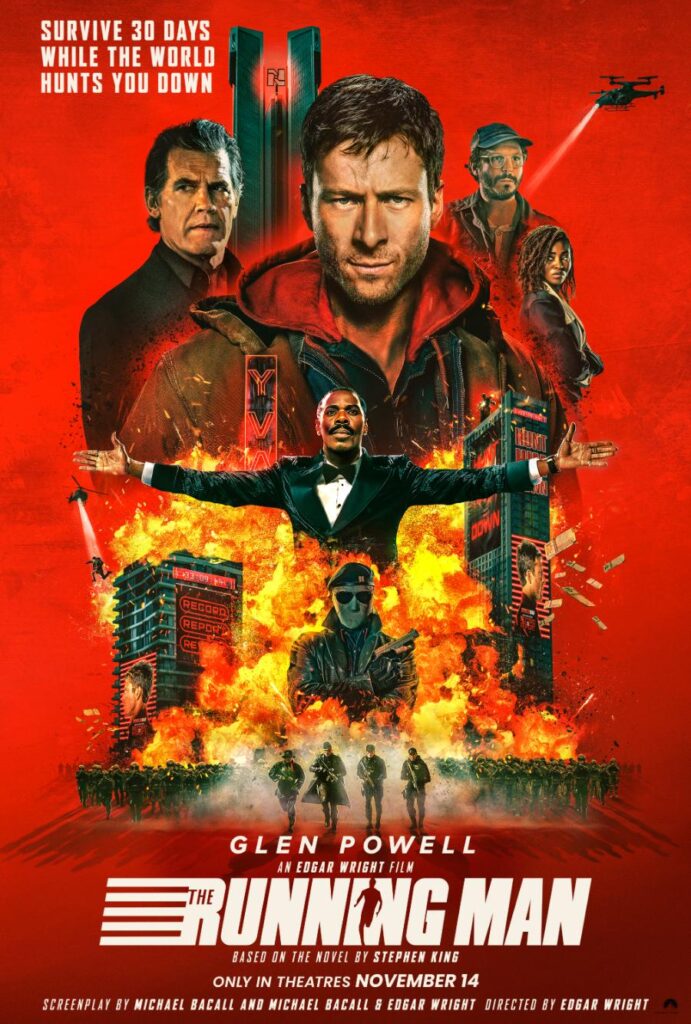
Edgar Wright’s The Running Man is a complex and layered remake of the 1987 Arnold Schwarzenegger vehicle, which itself was based on the Stephen King 1982 novel written using his pseudonym, Richard Bachman. Wright’s version hews much closer to the contents of the novel and tells the story of how, in the near-future dystopia of 2025, desperate people can be driven to do dumb things that leave them open to being manipulated to their detriment.
The Running Man is a 2025 Paramount/Skydance production directed by Edgar Wright from a screenplay by Wright and Michael Bacall. Glen Powell stars in the film along with William H. Macy, Colman Domingo, Lee Pace, Katy O’Brian, Josh Brolin, Daniel Ezra, Jayme Lawson, Emilia Jones, and Michael Cera.
“You are quantifiably the angriest man to ever audition for this show.”
“That really pisses me off!”
Ben Richards (Powell) has big problems. He’s been fired from yet another job for insubordination; his daughter has a bad fever; he can’t afford proper medical care or drugs for the kid, and he doesn’t want his wife, Shiela (Lawson), working nights since one of the other waitresses on that shift at the club was murdered and tossed in a dumpster. While their daughter coughs, the couple watch a twisted version of Wheel of Fortune on the Freevee, a show where contestants win prize money or plunge to their deaths. Richards resolves to go to the ICS network and audition for one of their game shows. Shiela makes him promise that he will not try out for The Running Man, ICS’ most popular show, because though the prize for surviving 30 days is one billion Nu dollars, no one has ever lasted that long to win the game.
The next morning, he marches to the network’s corporate tower in the swanky part of town and begins a series of physical tests of increasing difficulty that the broadcasters are using to cull the recruits. At several points, he stops to help others, and this selflessness is noticed. Soon, only three remain: Richards, a tough tomboy named Laughlin (O’Brian), and (thanks to Ben’s help) a hapless dork named Jansky.
Ben is summoned to the Executive Suites and meets Dan Killian (Brolin). Killian, the producer of The Running Man, has been observing Richards and tries to convince Ben that he has what it takes to beat his show, win The Running Man competition, and walk home with the billion Nu dollars. Remembering his promise to his wife and that his motives are to get his daughter medicine, not line his own pockets, Richards refuses. Killian counters with an offer of an advance that will be more than enough to get his daughter to a doctor and fill any prescription provided.
Richards relents, reneges on his promise, and accepts the offer. The staff informs him that his family will be moved to a hidden location for the duration of the show so that they’ll remain safe. When Ben rejoins the other two contestants, they’re told the rules of the game: The Runners get a twelve hour head start, a wad of chase money for them to spend as they will while they flee and a set of tapes that they have to record and deposit into designated drop-boxes every day of the game lest they immediately forfeit any prize money and still be hunted to death. During the hunt, their faces will constantly flash from every advertisement, phone screen, Freevee monitor all over the country and civilians are encouraged to call in location tips or even try to kill the Runners for cash prizes. Every day the Runners survive, their award increases, and they get a bonus for any Hunters they kill.
When the show begins, the host Bobby Thompson (Domingo) maligns and slanders Ben to the audience, rallying the crowd but sending Richards into a rage over the lies the Master of Ceremonies is telling about his family and he roars that he will return and burn the sky-scraping building to the ground.
Given his twelve-hour head start, Ben makes a beeline to his friend’s, a reclusive fence named Molie (Macy), who sets Richards up with false IDs and costumes. Ben then takes the first flight he can get to NYC and holes up in a luxury hotel. The moment the twelve hour grace period ends, the Hunters immediately trace Richards to Mollie’s hidden shop and torture him until he gives up the various aliases Molie gave Ben.
On the show, Jansky gets sold out by his Barista and cut down by a squad of Hunters as he leaves the coffee shop. Richards watches from the comfort of his luxury suite, confident in his ability to just anonymously wait out the 30 days. He records his message and drifts off to sleep, blissfully unaware that a team of Hunters, dressed as hospitality staff, has the hotel surrounded.
Can Ben escape this first real test of his ability to run? Will he ever be able to see his daughter or Shiela again? Can he make good on his promise to Killian and Thompson and burn their corporate tower down? Please watch The Running Man and find out.
“Never underestimate a cornered rat.”
Powell doesn’t emote particularly well. He can do smarmy and seethe with rage, but that’s the extent of the range he displays in The Running Man. He’s also huge; jacked; swole, and there’s no explanation for it whatsoever. He’s certainly not eating enough calories to maintain that physique, nor does he have a home gym in his sci-fi slum.
The production design of this “near-future dystopia” is strangely off-kilter. The apartments in Slumside really need painting, but other than that aren’t too shoddy and come equipped with Star Trek-style swooshing doors while the dilapidated Y in Boston is just a ratty, run-down structure from yesteryear featuring doors boasting hinges. The Parrakis home in Derry, Maine, along with the other structures in the town, looks like they could’ve been pulled from any other contemporary King story. Every car in NYC is either a classic from the sixties or something that looks like an electric shaver (and the city itself looks strangely smaller than it does today). The “futuristic” quad-rotor gunships used by the Hunters look like G. I. Joe toys, and the Throckmorton brothers get around in a Lincoln Town Car. The opening sequence of The Running Man show itself borrows heavily from the Stark Expo beginning depicted in Jon Favreau’s 2010 film, Iron Man 2 (though the Stark Expo did it better). Sprinkled throughout the movie are vehicles that bear a striking resemblance to the 6000 SUX from Paul Verhoeven’s 1987 satirical sci-fi classic, Robocop and as a nod to the first film, Arnold Schwarzenneger’s face is on the one-hundred Nu dollar bill. The only element that felt like it was out of an unseen tomorrow was the largely automated, super-luxury jet Richards boards in the final act.
This reviewer believes one shouldn’t remake good movies. The capitalist urge is to remake films that resonate and come with a built-in audience for greater box-office reward. The creative urge is to remake BAD movies and make them better films. That said, The Running Man is one of Ahnold’s sillier movies, in which each of the ever-more cartoonish hunters pursuing him are hoisted on their own petards.
That’s not what the book is about. The dystopia and subsequent revolution the novel depicts is not fit for Saturday morning TV viewing.
Wright is an excellent director who marches to his own drums. His adaptation of King’s work has tonal inconsistency as it occasionally spirals into silliness while going in several directions at once. The slapstick humor, Dad Jokes galore, the host of the show doing the actual Running Man Dance, clever banter, ‘zine-boosting street-preachers, soap-making members of the resistance, carjackings, casinos, immolated ladies, bullet-riddled bodies, Hunters, hostages, hand grenades, and one VERY stubborn hotel towel all serve to obfuscate what lies at the heart of The Running Man.
There is a message movie buried behind all the aggressive and boisterous pew-pew-pewing. That message is bafflingly, Bill and Ted like: “Be excellent to each other!” You can be strongAND kind; Don’t believe everything you see on TV (or in a movie)! There is a cohesive class-war vein being mined in this powerful and substantive statement against oligarchy that is delivered, like a fish wrapped in paper, disguised as a ’splody, snarky, shoot-em-up, splatter-fest. The irony is hard to escape: “Please pay the oligarchy to see a film about how to resist the oligarchy.” The Running Man is entertaining and is a good movie with something to say that hits its marks but stumbles a bit in its race to greatness.
The Running Man is in theatres Friday, November 14th.