

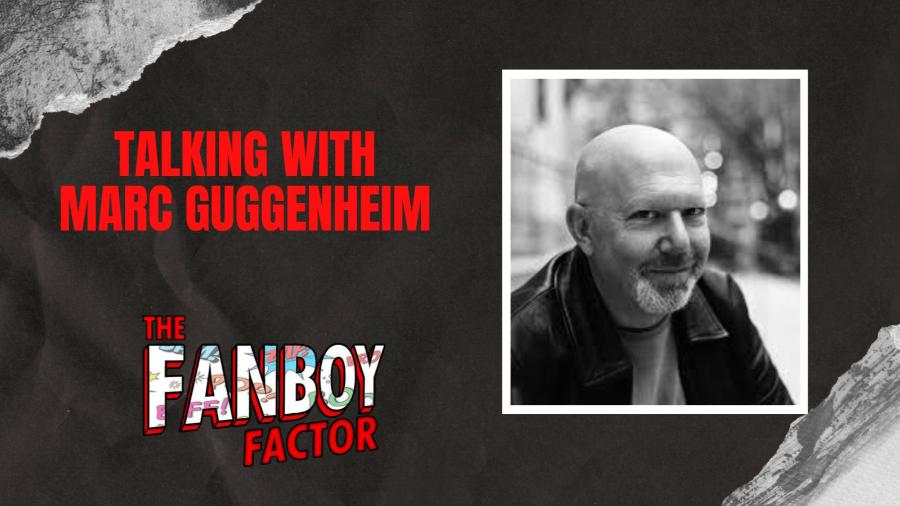
Marc Guggenheim is a writer and producer whose career spans comics, television, and film. In comics, his work includes projects for both DC and Marvel, while in television he is best known as one of the architects of the CW’s Arrowverse, including Arrow and Legends of Tomorrow. Across mediums, Guggenheim has built a reputation for character-driven storytelling grounded in genre traditions and structural rigor. His latest project, The Whisper War, marks a return to creator-owned science fiction, expanding his work in comics through a new, ambitious universe developed for Comixology.
Interviewee: Marc Guggenheim
Interviewer: Anthony Andujar Jr
On planet Imprimata, in the capital city of Apperax, a murder has been committed—and Axel Jindari has been chosen to investigate it. With no suspects, no forensics, and no clear theories to pursue, Axel must rely on intuition and an unsettling sense of déjà vu as he navigates a case that mirrors the unresolved mysteries of his own life. This premise forms the foundation of The Whisper War, a new science-fiction noir from Marc Guggenheim that blends procedural tension with expansive world-building. In the following interview, Guggenheim discusses his path into comics, the evolution of The Whisper War, and the creative questions driving this new chapter of his storytelling.
Q1. Marc Guggenheim is a prolific creator, having worked in comics, television, and film. Whether it’s having worked at DC Comics, creating the CW Arrowverse, Marvel Comics, etc., he continues to add to his body of work. Guggenheim is now releasing a brand new comic series on Comixology titled The Whisper War. The first thing I’d like to ask is, what started your path into the comics medium, and how did it open the doors into other mediums that continue to nurture your enthusiasm for storytelling within comics?
MG: Oh, great question. For as long as I can remember, I’ve loved comics. I don’t recall a time in my life when I didn’t love comics. One of my earliest memories is sitting on the floor of my room, flipping through the pages of a Superman comic. I didn’t read it, however. I didn’t know how to read at that point.
In college, I interned for Marvel Comics and, deep down, really wanted to become a comic book writer. But I didn’t have the courage and took the safer route of becoming an attorney. But I still wanted to be a writer, so I eventually transitioned into writing for television. Why not comics? Well, the truth is that it’s easier to break into Hollywood as a writer than it is to break into comics. In Hollywood, you’ve got agents, managers — back when I was starting out, there was something called “TV staffing season” — there were on ramps for emerging writers. Comics have none of those things.
So, actually, it was writing for television that opened the door to writing comics, not the other way around. I was in my sixth year of writing for TV and just coming off three years on Law & Order. This was around the time when screenwriters Joe Straczynski and Kevin Smith were writing for Image and Marvel, and they kinda opened the door to comics for Hollywood writers.
Q2. The Whisper War follows the story of Axel Jindari, an investigator of the city of Apperax. What is it about Axel as a character that made him central to this world and the story that is set to unfold?
MG: The big thing about Axel is that he’s placed in the position of investigating a mystery while, unbeknownst to everyone else, his whole life is a mystery. There are elements in his life that he can’t understand or reconcile. So, he’s conducting this private little investigation at the same time he’s assigned to investigate a murder. I just really liked that duality.
Q3 When developing stories, what is your go-to routine as a writer? Does it start with Post-it notes? A notebook? A digital drive? How do you compile the many drafts and concepts until it becomes the completed story that you set out to publish?
MG: I actually just do a lot of thinking in my head before starting to put pen to paper. I feel like the best ideas — or, at least, my best ideas — come when my mind is wandering, thinking of other things. Then, once I feel like I have a critical mass of ideas, I start organizing and supplementing them longhand. I used to work on yellow pads and then scan those pages into my computer. Now, however, I work digitally from the start, writing with an Apple Pencil on my iPad in a notebook app (I use Noteshelf).
Those notes wouldn’t make sense to anyone. For one thing, my handwriting is horrible. For another, I’m writing down just fragments and questions. If you’re able to make sense of my writing, it would come off like the ramblings of a madman because I’m basically talking to myself on the page.
Q4 What was the development process of Whisper War when it came to Comixology as the publisher, and the art and editorial team selected to help spearhead the book to publication?
MG: Whisper War is the first time I’ve created a comic for a specific artist. Sedat Oezgen had worked on a project with a friend of mine, and I got to know him, and we resolved to do something together. Much of the genesis of Whisper War was based on the kinds of things I believe Sedat gravitates to as an artist.
Sedat then brought in Carlos Cabrera to color — but the truth is that Carlos is much more than a colorist. He’s really functioning like a co-artist, providing not just the color and lighting, but rendering shapes and details. The combination is really special and, dare I say it, new.
I was talking with Jeff DiBartolomeo at Comixology and just showed him some of Sedat and Carlos’ pages, and his hands practically broke through the Zoom screen to grab the pages like, “I want it!!!!” He was like Gollum with the ring. It’s hard to compete with that kind of enthusiasm.
Whisper War is the second project I’m doing with Comixology, and I realized that I needed some help on the editorial side. I know just enough about comic book production to be dangerous, but the gaps in my knowledge are vast. Also, I’m juggling a lot of different projects — both in comics and Hollywood — and I needed a different pair of hands to keep the trains running on time. My friend Alex Segura recommended Chris Robinson, whom I’d worked with back when he was at Marvel, and Chris has been an absolute godsend.
Q5 What kinds of Sci-Fi concepts and genres were discussed that you aimed to explore with this series that appealed to everyone on the creative team?
MG: If you look at Sedat’s portfolio, when left to his own devices, he likes to draw sci-fi — specifically, vast cityscapes and extraterrestrial (but not necessarily “alien”) environments. So I started out with those kinds of images in mind. At the same time, the WGA writers’ strike was going on, and there’s an argument to be made about the 2023 strike being a reaction to the new technology introduced coming out of the 2007 strike. Which is a long way of saying, I got interested in the idea of technology coming out of one conflict sparking another conflict.
Q6 The Whisper War appears to be a five-issue series. Is this intended to be a standalone series with five parts, or will there be more adventures for Axel Jindari to explore that readers will want to follow?
MG: You’ll see that we’ve added a brand to each of the covers: The Shattered Realm. Because Sedat and I see ourselves as creating a universe, not just one five-issue story. We’ve talked about other Shattered Realm tales — some not even necessarily in comics — that all take place in this universe. Whether those stories include Axel, well, you’ll just have to see.
Q7 As a storyteller, what was the mission going in when creating The Whisper War? What were the foundational messages that you wanted to explore via Sci-Fi that made you say, “This is the kind of book I want to make.”
MG: Inspired by Sedat’s portfolio, I got very interested in a story that starts like a sci-fi noir à la Blade Runner but then expands into a galactic conflict à la Star Wars. I’ll leave it to readers to decide if we pulled that off, but that was the — for lack of a better word — “mission statement.”
Q8 Where can readers follow your work for updates and installments of The Whisper War?
MG: I’m on BlueSky and Instagram as @marcguggenheim, but the best place to go for information about my work is my semi-weekly newsletter, LegalDispatch, on Substack as marcguggenheim.substack.com.
 Dan Kleiner