

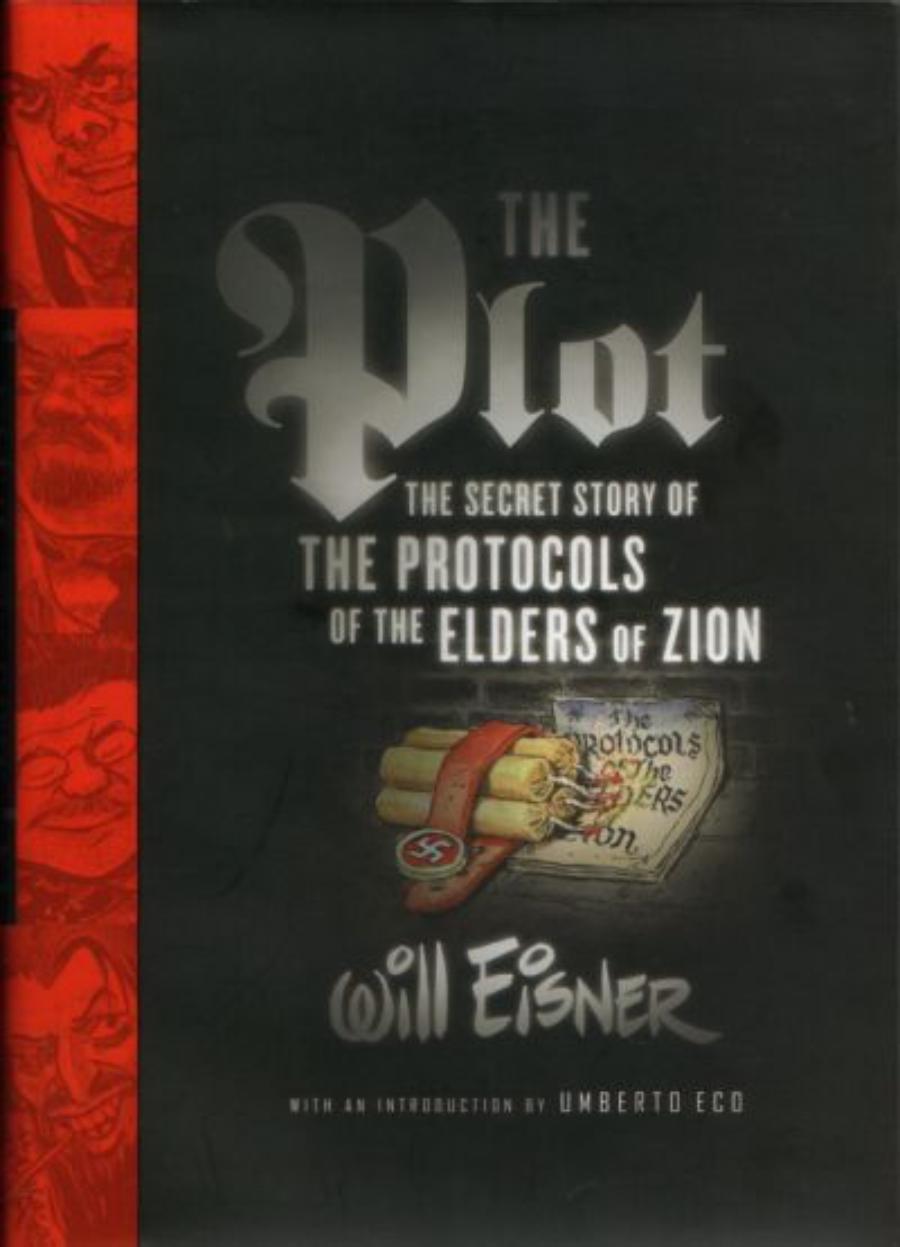
Lies don’t disappear when they’re exposed—they evolve.
In The Plot: The Secret Story of The Protocols of the Elders of Zion, Will Eisner traced the life cycle of one of history’s most dangerous conspiracies, leaving behind a warning that feels more urgent now than when the book was first published.
One of Eisner’s most powerful works, The Plot is a nonfiction graphic novel that investigates the origins, spread, and enduring impact of The Protocols of the Elders of Zion, one of the most notorious and destructive antisemitic forgeries in modern history.
The Plot would also be Eisner’s final work. He passed away on January 3, 2005, and the book was released posthumously in June 2005. It was his first fully investigative, historical nonfiction graphic novel and the result of years of research conducted prior to his death. As such, the book reads not only as a historical exposé but as a culminating statement at the end of Eisner’s career.
The narrative traces how The Protocols were fabricated in late-nineteenth- and early-twentieth-century Russia, drawing heavily from earlier political satires and propaganda. Falsely presented as the minutes of a secret Jewish cabal plotting global domination, the document was weaponized by political actors seeking to scapegoat Jews during periods of social unrest, revolution, and economic instability.
As the narrative moves across Europe and into the United States, The Plot documents how the forgery was repeatedly exposed—most notably by journalists and scholars—yet continued to spread regardless. Eisner emphasizes a central paradox: truth alone was never enough to stop the lie. Even after being conclusively debunked, the Protocols persisted because they served ideological needs, reinforcing long-standing prejudices and fears.
“Truth alone was never enough to stop the lie.”
Eisner also examines how the Protocols were amplified by influential figures, republished across cultures, and later embraced by Nazi propagandists, contributing directly to the climate of hatred that enabled the Holocaust. The book concludes by showing that the Protocols did not disappear after World War II; instead, they resurfaced in new political contexts, conspiracy movements, and extremist ideologies around the world.
Ultimately, The Plot functions not only as a historical exposé but as a warning about the enduring power of misinformation. Eisner argues that lies, once embedded in culture, can outlive their creators—and that vigilance, education, and historical memory are essential to resisting them. Many critics have read The Plot as Eisner’s final, deliberate statement: less a career project than a moral warning about how propaganda, once unleashed, never truly disappears.
The Plot is more important now than ever, especially in the political and media climate created under the presidency of Donald Trump. Eisner’s work exposes the mechanics of antisemitic conspiracy thinking—how lies are repeated, legitimized by authority, and embraced by those who believe themselves immune to their consequences. That warning lands with particular force today, including for Jewish supporters of Trumpism, who have chosen alignment with a movement that routinely traffics in conspiracy culture, historical denial, and rhetoric long used to target Jews themselves. The Plot makes clear that antisemitism does not announce itself politely or consistently; it adapts, it mutates, and it often gains power through the complicity of those who believe it will never turn on them. Eisner’s book offers no comfort on this point—only a blunt historical record of what happens when propaganda is normalized and warning signs are ignored.
Eisner himself was Jewish, and while he was not religiously observant, he was deeply Jewish in a cultural and ethical sense. His Jewish identity, history, and moral framework informed much of his later work, including A Contract with God, To the Heart of the Storm, and The Plot. That perspective gives the book additional weight, grounding its historical analysis in lived experience and moral urgency rather than abstraction.
Reading books like The Plot and Maus is not an academic exercise or a matter of personal taste; it is an act of historical responsibility. These works exist because lies, hatred, and propaganda do not remain confined to the past—they recur whenever societies forget how easily truth can be distorted and weaponized. Eisner and Art Spiegelman use the graphic novel not to soften history, but to make it unavoidable, forcing readers to confront how ordinary people are pulled into systems of cruelty through fear, denial, and willful ignorance. In an era when misinformation spreads faster than fact and history is routinely minimized or rewritten, books like these function as safeguards. They remind readers that memory matters, that vigilance is necessary, and that understanding how hatred operates is the first step in refusing to participate in it.
 Dan Kleiner