

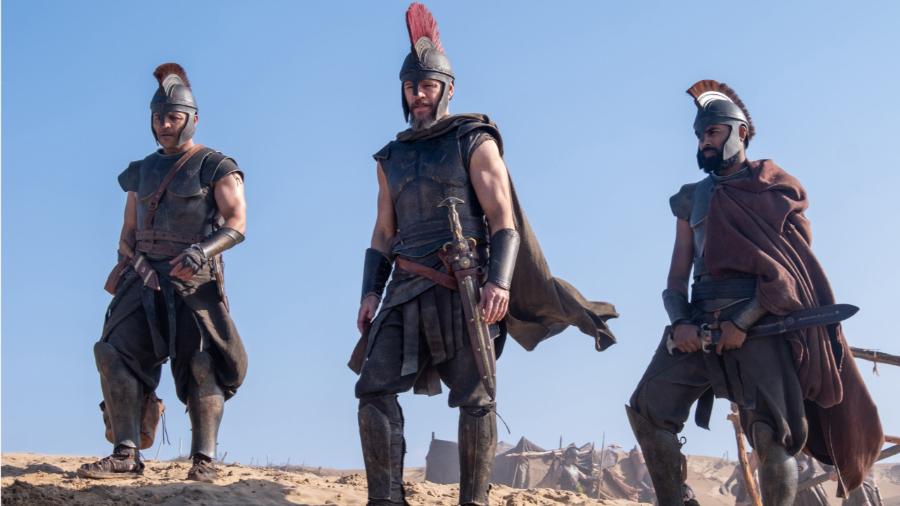
“To burn the walls of Troy was to burn the entire world.”
The Odyssey is a dour and desaturated film. The movie desperately needs a more vibrant color palette. Despite this, the picture is an extraordinarily well-made and entertaining adaptation of an ancient epic poem. The picture is packed to the gills with very talented people acting their tunics off. While AN odyssey is known to mean a long and perilous journey, this film, The Odyssey, is an excellent swords, sandals and sorcery movie with a brisk pace that belies its two-hour, fifty-three-minute run-time.
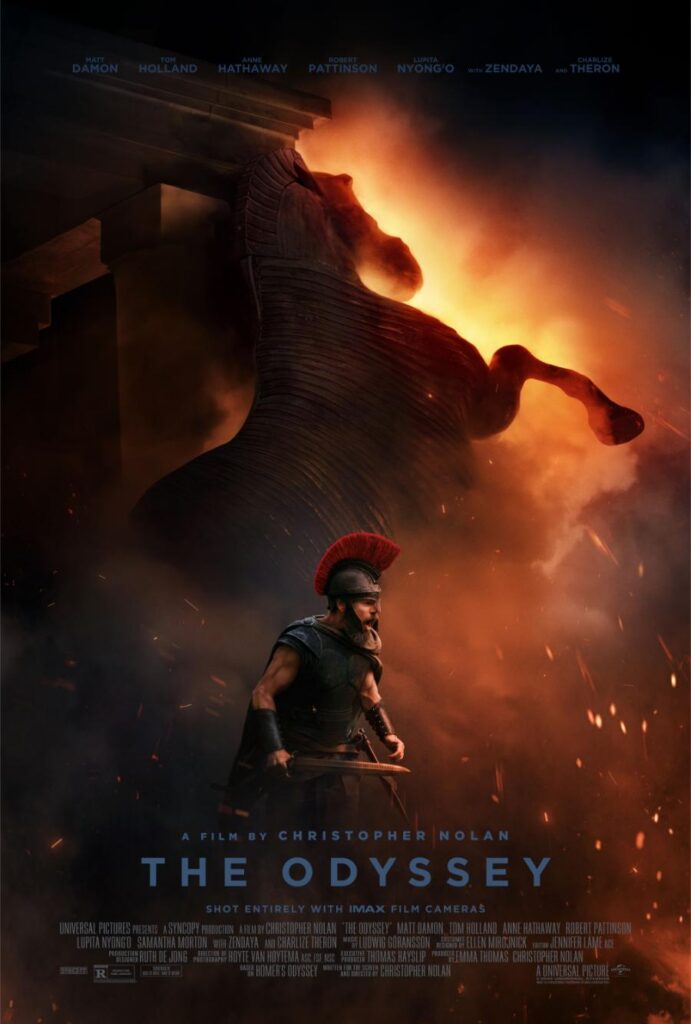
“Your memory won’t be making any decisions.”
The Odyssey is a 2026 Universal Pictures film written and directed by Christopher Nolan, based on the epic poem by Homer. Matt Damon leads a large ensemble cast including Ann Hathaway, Robert Pattinson, Lupita Nyong’o, Charlize Theron, Tom Holland, Samantha Morton, Zendaya, Jon Bernthal, John Leguizamo, Mia Goth, Elliot Page and featuring James Remar as the blind prophet, Tiresias.
“You don’t have to be the strongest or the fastest if you can be the smartest.
It is seven years after the gates of Troy fell, nearly twenty since King Odysseus (Damon) took his retainers and sailed off to war. On the island Kingdom of Ithaca, Queen Penelope (Hathaway) is beset by throngs of ill-mannered suitors led by Antinous (Pattinson), who want Penelope to acknowledge the death of her husband, allowing them to woo and take her hand in marriage. This infuriates her loyal son Telemachus (Holland), who is adamant that his father still lives. When he learns that both Menelaus (Bernthal), King of Sparta and his brother, Agamemnon, King of Mycenae, who commanded the Achaean armies during the war at Troy, have both returned home, he decides to sail to Sparta and ask the great king for any tidings or news of his father’s whereabouts.
Antinous wants Telemachus out of the picture but can’t murder him outright in Odysseus’ own halls without violating hospitality laws and losing any chance he would have of marrying Penelope. When he learns of Telemachus’ quest, he sends his own men to disguise themselves as monks, waylay the young prince at a shrine and kill him dead before Telemachus can return to his mother and strengthen Penelope’s resolve with knowledge of her husband’s fate.
In the meantime, a bedraggled Odysseus placidly sits on the beautiful beach of the Island of Ogygia, being fed magical lotus leaves by the daughter of Atlas the Titan, the nymph Calypso (Theron). She has fallen in love with the architect of the Achaean victory and wants him to stay with her forever. The lotus leaves have dulled Odysseus’ senses and warped his memory to the point that he’s forgotten his ambitions, his crew, his son and his beloved wife.
Can Telemachus pry any information as to Odysseus’ status out of the King of Sparta? Can Penelope resist Antinous’ advances and hold out for her husband’s return? Can Odysseus regain his sharp wits and prodigious memory so he can attempt to escape Calypso’s enchanted influence and return to his long-lost family? Please see The Odyssey to find out.
“Love is not a sacrifice.”
“Of course it is!”
The film says The Odyssey takes place in “a time of apparent magic”. The real magic is how they got that damned wooden horse through the city gates. The giant equine, fashioned from flotsam and fragments of Greek ships, is immense. As the designer, wily Odysseus definitely would’ve measured the gates. Nolan doesn’t care. The scene with the Sack of Troy is a master class of wound-up tension and dramatic denouement, punctuated by displays of Odysseus’ uncanny marksmanship, a set of Chekhov’s skills and a marker laid down that pays off handsomely in the final reels.
The ships of Odysseus’ squadron are odd anachronisms, bearing more resemblance to Viking longboats that ply the seas two thousand years after the story takes place rather than the penteconters or triaconters that frequented the Mediterranean Sea at that time of the war at Troy.
For a very smart guy, Odysseus isn’t too keen on self-reflection. He often talks about changing his stars, defying his fate, ignoring the gods. “The gods help those who help themselves,” says the man, never at a loss and always with Athena literally at his side.
Part of the reason Odysseus spends a decade coming home is that he’s incurred a curse from Poseidon by blinding his son, Polyphemus the Cyclops. The design of the legendary cyclops is ingenious, with a lone, sideways eye slowly blinking. That sequence is abridged. Nolan completely leaves out Odysseus’ bantering with the demigod. There is no alias of “No One” or “Nobody” provided. After the monster has devoured several of their fellows, they don’t reason with the cyclops; they just wait until he sleeps, and then they poke his eye out with a smoldering log from his campfire. Flush with pride after making his escape, there is no moment when Odysseus outs himself to the cyclops, announcing his name, his home, and giving Poseidon a target for his wrath.
Nolan also merges several characters and events. Odysseus and his crew do not land on the Island of the Lotus-Eaters. Instead, after yet another shipwreck, he is fed the nepenthean plants by the seductive Calypso who selfishly wants to keep Odysseus for herself. The unnamed, fully armored ogres that tear apart two ships of Odysseus’ squadron while slaughtering dozens of his sailors are the Laestrygonians, a race of cannibals.
In a tiny bit of cinematic brilliance, the sound cuts out as Odysseus’ sailors plug their ears with wax as to not be tempted by the Sirens and their supernatural call. The Sirens are not shown on screen, not even for a moment. Nolan has chosen to focus on Odysseus’ agonizing reaction as he listens to their sorcerous serenade while lashed to the mast. Scylla looks unfinished, a lumpy brown mass of giant, toothy tentacles, and the depiction of its partner, the swirling maelstrom of Charybdis, severely lacks imagination.
The picture is peppered with flashes of humor. One of the biggest laughs in the film wasn’t even in the movie. At one point, Jon Bernthal’s grizzled Menelaus asks Holland’s Telemachus, “Have you heard the tale of the Horse? Have you heard it from the insiiiide?” and guffaws burst from the audience, many of whom turned to their friends and said “on weeeeeed?!?” like Jon Stewart in 1998’s Half-Baked.
The story of the fall of Troy is linked to a period of time called the Bronze Age Collapse. Due to an aggregation of disparate reasons, including years of drought, attacks, famines, wars, and other political pressures, the most sophisticated empires, kingdoms and cultures of the time were weakened and then simply laid to waste or greatly reduced. Many of the municipalities of that era report repeated raids by an amorphous bands of brigands known as “The Sea Peoples.” The Bronze Age is known as such due to the proliferation of bronze weapons, armor, and artifacts. Bronze is an alloy made from copper and tin. Copper was somewhat ubiquitous, but tin certainly wasn’t. Before the Collapse, a complex arrangement of trade routes stretched from the Mediterranean to the British Isles, where tin was mined and shipped south. Afterwards, that network falls to pieces, taking the ability to read and write along with it. At the time, Literacy was strongly connected to the nobility, priests, and managerial classes responsible for keeping ledgers. With the leadership of these sophisticated nations decapitated, literacy was lost. That led to the cruder Iron Age, where science and technology took a great big leap backwards. Bronze could be cast. Iron, which is both harder and far more brittle than bronze, had to be forged.
One of the more interesting aspects of the film is that by sneaking soldiers into the city and then sacking Troy, Odysseus has violated the Laws of Hospitality, committing a sin against Zeus. On his arduous voyage home, Odysseus’ men continue that practice, frequently raiding for supplies. At the same time, Penelope and Telemachus must fend off the advances of Antinous and his fellow suitors, who are abusing those laws, gorging on Odysseus’ food and wines during repeated feasts as well as taking advantage of the Queen’s generosity. Having seen the effects breaking the rules has had on his ships and sailors, Odysseus insists to Telemachus that they remove the parasitical suitors in a manner that shows respect to Zeus and his authority.
Nolan pulls off a very interesting trick, basically a Scooby-Doo mask-pull moment. After a long decade of war, flush with victory, the remnants of the 1000 ships abandon the Trojan shore and disperse. The weary sailors and soldiers returning after ten years, raiding, foraging, and plundering on their way home, ARE the self-same “Sea Peoples”. The heroes of the last story are the very terror looming over the horizon that has been building in the background through panicked whispers over the runtime of The Odyssey.
It makes for an interesting temporal suggestion, placing the fall of Troy smack in the middle of the Bronze-Age Collapse. Nolan may also be drawing a parallel to a part of Alan Moore and Dave Gibbons’ sublime 1986 series, Watchmen. There is a comic within the comic of Watchmen, called The Tales of the Black Freighter. A kid named Bernie is shown reading issues of the book at a newsstand. The story is called Marooned. It is the tale of a sailor who is desperate to get back home after a pirate attack, hoping to warn his family and friends about the imminent danger of the Black Freighter. Creating a makeshift raft out of the bloated bodies of his shipmates, he travels a dark and twisted path, hoping to stave off disaster. Shedding inhibition after inhibition, he becomes more of a danger to his loved ones than the pirates ever could be. After the most disastrous of climaxes, the forlorn sailor returns to the beach where, looming out of the darkness, the freighter lies waiting. They had never come for the town; they had only come for him, a depraved, calloused, and hard-bitten recruit. The tenacious Achaeans, returning from war, threatening their neighbors, are that recruit.
The Odyssey is an exceptional accomplishment. Production design is very impressive. The world of the ancient Achaeans looks lived-in and believable. Damon, Hathaway, Holland, and Pattinson are all at the top of their games. Leguizamo is phenomenal. Academy nominations are warranted. This star-studded version of The Odyssey has an appeal outside that of the typical genre fan and is of a higher quality than most swords, sandals, and sorcery films could ever dream of being. This film should not be missed.
The Odyssey is in theatres July 17.
 Anthony Andujar Jr.
  Newsdesk