

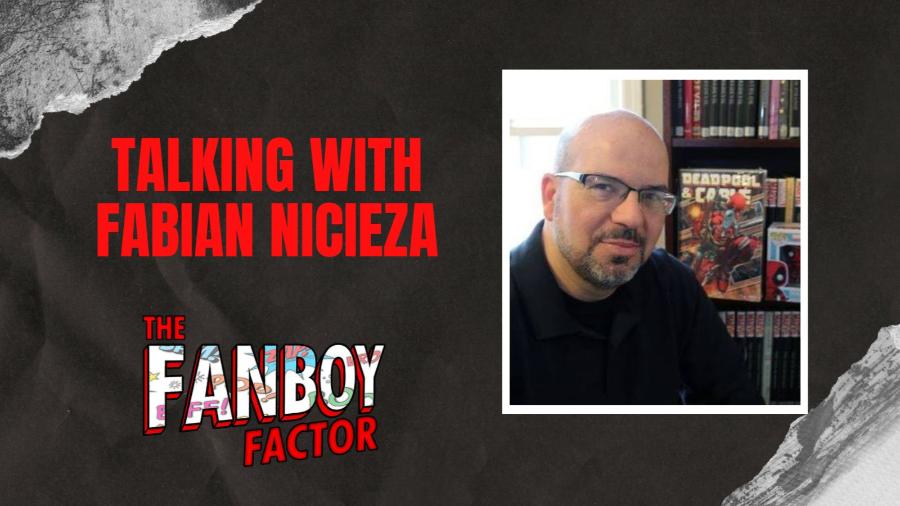
Comic fans know Fabian Nicieza as one of the most influential writers of the modern era, thanks to his celebrated runs on X-Men and his co-creation of Deadpool. His latest project, Deep Down, takes readers in a very different direction. Created alongside Jeff Gomez and Steele Filipek, the upcoming graphic novel is an urban crime thriller with supernatural elements set within the hidden depths of New York City’s subway system. The project has already earned Kickstarter’s prestigious “Project We Love” distinction ahead of its launch, signaling strong early excitement for the series.
Recently, Anthony Andujar Jr. had the opportunity to speak with Fabian Nicieza about Deep Down, its unique setting, and what readers can expect from this new world…
Q1 You’ve worked on a plethora of prolific and iconic stories and books throughout your tenure in the comics industry. What is it about the medium that continues to keep you invested as a creative?
FN: Pictures and words, simple as that. I have loved the storytelling form since I was six years old. Creatively, I have always been interested in different platforms, and have worked hard to diversify my skills to suit a variety of needs, but comic books will always be in my DNA.
Q2 You currently have a 3-issue comic series titled Deep Down, developed by Jeff Gomez, Kay Rothman, Dana Kuznetzkoff & Mark Pensavalle, that you’re working on with co-collaborator Steve Filipek, illustrator Felix Ruiz, Art Director, and colorist Chrysoula Artemis. What led you to work on this project? And what was the collaboration process like, coordinating with the team for the story to effectively meet the finish line that satisfied you creatively, and the rest of the team?
FN: I have worked with and as part of the Starlight Runner team for over 20 years. They are friends and colleagues, so when Jeff asked me to sweep the steps and polish the brass to make the foyer entrance for this new story world as spiffy as it can be, it was my pleasure. Steele handled the grunt load of the work, and I just tossed my experience in here and there.
The project took time to develop, took time to research, took time to write, and took time to be drawn, so what has been most rewarding to me is to see all of that long and hard work come to fruition with a book that exceeded my expectations and then some!
Q3 Deep Down is a crime thriller with occult undertones, centered on a missing-persons case in which a young autistic girl goes missing, leading to a deeper mystery beneath the city. It’s up to TSO Agents Verge Gurrero, Joe Weber, and the rest of the NYC Transit Special Ops team to investigate and solve the case. It’s not often that readers see stories centered around Transit Special Ops teams and investigations pertaining to that. Was there research developed before writing this story to get a solid grasp on how transit special ops teams operate before writing this series?
FN: Because at that time, my involvement with SLR wasn’t on a daily basis, I missed out on some of the fun parts of the research required, but we did have a wealth of information to draw from. I think it was an idea that appealed to each of us for different reasons. I spent a few years living in Queens when I first came to America — not knowing that two younger kids from the same general area — Jeff and Mark — would one day become friends!
So for all of us, there was an allure and an excitement to the notion of developing a story world that exists in reality but is completely foreign to so many people — even residents of NYC –, and that is the world that is underground. It’s an interesting world to explore and expand on, allowing the structural aspects of police procedurals that are so fun to watch (and read and write) to be seen in an interesting new light.
Q4 Agent Verge Gurrero and Joe Weber are two of the protagonists of this series. What is it about Gurrero and Weber that made them the central characters to write about? Were there any particular parallels to the two that reflect the layered themes of the story that reflect its themes of what lies beneath?
FN: The development of the squad members was all done independently of my involvement. The hard work of developing them fell on Steele and the rest of the team. I might have kibitzed a bit here and there on dialogue nuances, but when I was given the character bible outlines, they were already solid and interesting characters.
I think their personalities are so different, as are their methods for achieving what they want achieved, that we are given a chance to explore the conflicts police have to face every day, the down and dirty “boots on the ground” vs. the drudgery of bureaucracy vs. navigating the sticky and selfish politics of City Hall.
Q5. When writing this series, was there a particular set of music or soundtracks that helped guide the creative and thematic process of the story? Was there a particular mood board or a set of references from movies that spearheaded the kind of tone that you wanted to collectively portray for this book?
FN: We had a wealth of photo references that helped give us that “sweaty Al Pacino in an early 70s cop movie” vibe we were going for. It’s funny, because I lived through aspects of all of that time and tonal range — even though I was a suburban kid in Jersey by 1969 — all I have to do to feel it is close my eyes, because we went to Manhattan from Jersey every other weekend when I was young. My parents were born and raised in Buenos Aires, and city-living was in their blood. Meanwhile, Mark and Jeff, having been born and raised in the city, basically have hot dog water running through their veins.
Q6. The series has a social commentary that focuses on cases that exemplify the neglect of minority communities of varying demographics and inequalities that leave communities denied support. How did that inform your writing for this book, and with the rest of the creative team that skits the line between entertainment and reflection/critique on the harsh realities of life?
FN: Well, one thing SLR has always been about is telling stories of marginalized characters in conflict that would appeal to a wide audience. Characters who strive to be seen and aspire to be valued for who they are, not what they look like, resonates with audience members who feel the same way.
Kay and Dana in their television and theatre work, have also focused on that, which is why we all were able to work so smoothly together. I have, from the very beginning of my career, from Psi-Force to New Warriors to X-Men and up to my current prose work, searched for themes of commonality among diversity. I think it makes for better characters, which makes for better stories, which tends to make for a better reading experience.
Q7. Are there plans for a follow-up to this project, and if so, what would you be interested in exploring? Would it be an expansion or an exploration of themes that have yet to be explored in this project?
FN: I think the team would love an opportunity to tell more stories in the Deep Down and I’m ready to dive in if we get the chance!
Q8. Where can readers follow your work?
FN: I’m really lazy about updating my author website with new information, so the best way to reach me or hear any updates is through my socials on Facebook, Instagram, Threads, or BlueSKy.
 Dan Kleiner