
“I try to avoid violence.”
The Mandalorian and Grogu is a well-made, mid-stakes, self- contained, action-oriented adventure full of Easter eggs. The film effectively resets the Mandalorian for future missions in the employ of the New Republic and lays the groundwork for the next set of movies. Hopefully, those future features will resolve several of the plotlines left dangling by Star Wars’ chief creative Dave Filoni in his various live action and animated series, including 2023’s Ahsoka, 2021’s The Bad Batch, and 2014’s Rebels. All have unresolved issues. One of Filoni’s dangling plots dealt with in this film stretches all the way back to 2008 and the Filoni-directed, Star Wars: The Clone Wars animated movie, where the character of Rotta the Hutt makes his feature debut with Ahsoka Tano.
“I can bring you in warm, or I can bring you in cold.”
The Mandalorian and Grogu is a 2026 Lucasfilm picture directed by Jon Favreau from a story written by Dave Filoni, Favreau, and Noah Kloor. Pedro Pascal (along with Brendan Wayne and Lateef Crowder) stars as Din Djarin, the titular Mandalorian, with Sigourney Weaver and Johnny Coyne. The picture features the vocal talents of Jeremy Allen White, Steve Blum, and Martin Scorsese, among others.
“You see, we CATCH the bad guy, he tells us where the OTHERS are.”
“Things got complicated.”
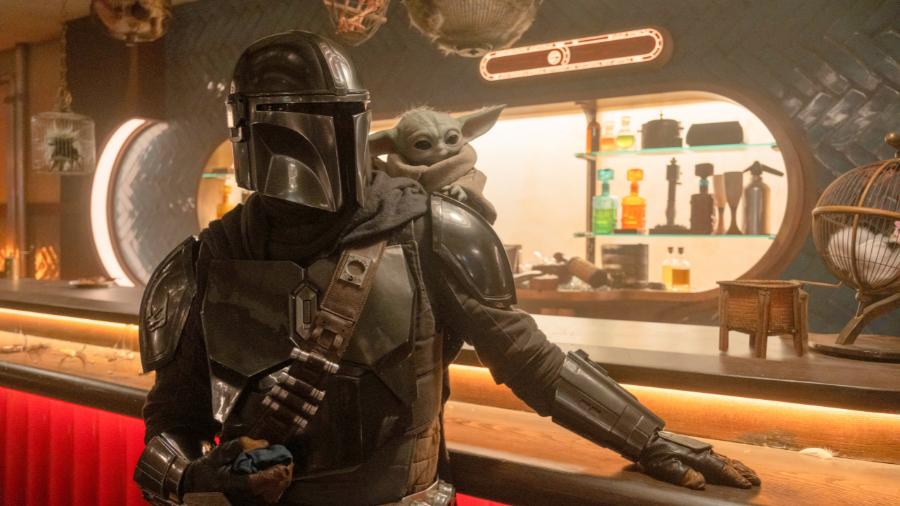
Din Djarin (Pascal, etc) has been hired by the New Republic to help mop up the Imperial Remnant by capturing the few remaining leaders. On one such mission, despite his gleaming Beskar armor, the Mandalorian is a wraith, able to invisibly infiltrate. Moving like the wind and striking from the shadows, Djarin surprises the Remnant Stormtroopers with the speed and ferocity of his attack, mercilessly immolating any troopers who escape his blaster bolts with his wrist-mounted flame-thrower. Despite unleashing several AT-AT’s and an army against the Mandalorian, the commander meets his fate chiefly due to his cowardice.
Zeb (Blum) picks Din and Grogu up in a U-Wing and ferries them to meet Colonel Ward (Weaver), one of Zeb’s superiors in the Adelphi Rangers, the organization the New Republic has assembled to police the Outer Rim. Ward wants to hire Djarin to bring in Commander Coin, one of the last Imperial holdouts. The Hutt Twins (last seen in The Book of Boba Fett) know where Coin is holed up but will only divulge this data if their nephew, Rotta the Hutt, is rescued from a syndicate run by crime Lord Janu and returned safely to them.
Din is reluctant, but Ward entices him to do her bidding with an amazing pre-payment: a stock ST-70 assault ship that he can modify to match his missing Razor Crest. Tracking down a rumor, Djarin and Grogu make their way to one of the moons of Shakari. In a neon-lit, neo-noir slice of a megalopolis, pier columns and support bents rattle as a humming bullet train flashes overhead on elevated tracks. Djarin digs a little, finds a lead, and pays a visit to Lord Janu’s court, where, in a veritable hive of scum and villainy, he and Grogu are introduced to Rotta the Hutt.
The boy Hutt has grown into a mighty gladiator, swollen with muscles and marked with many scars. He’s resistant to Din’s demands, adamant that his aunt and uncle want him dead. He is the son of Jabba the Hutt, and if they knock him off, they can get their hands on their brother’s criminal empire. Rotta isn’t interested in returning to that life. Rotta enjoys the arena, where he is showered with adulation and praise. His crime lord father was feared. As a champion, Rotta wants to be loved. He refuses Djarin’s offer.
After confronting some of Janu’s thugs and mowing them down like grass, the Mandalorian is hit with gas and rendered unconscious. He awakens, still clad in his Beskar armor but stripped of his every weapon. He can see them, along with his jetpack, tantalizingly close but kept from him behind a scintillating, scarlet, security screen. He is funneled into a round arena with Rotta in the center, Rotta armed with an axe, Rotta hungry for blood.
Djarin garottes the Hutt and gets him to calm down, realize that his buddy Janu has bet against him, that he’s been set up to die. The insanely muscular worm relaxes a little and begins to listen.
Janu can’t have that. He ups the stakes and releases his pit-monsters. All of them. The horrors unleashed are the nightmares that every Dejarik player knows on sight like the ferocious K’lor’slug, the colossal Mantellian Savrip, or the fearsome Kintan Strider, except these weren’t holo-monsters on a chessboard in a starship’s rec-room, but rather ravenous beasts each hoping to dine on Din Djarin and Rotta the Hutt.
Can Din survive this multi-tier arena-battle without any of his trusty Mandalorian weapons? Can Rotta get it through his thick skull that he’s being set up? Can Grogu get out of his cage and make a difference? Please see Star Wars: The Mandalorian and Grogu to find out.
“The old protect the young, and the young protect the old. This is the way.”
Jon Favreau confirmed that the outstanding 1970’s manga Lone Wolf and Cub by Kazuo Koike and Goseki Kojima, which is a story about a rōnin samurai raising his child while carrying out missions of vengeance, was a considerable influence on the dynamic between Din Jarin and Grogu.
The opening hearkens back to classic Bond films; the Mandalorian breezes through the Imperial Remnant soldiers as an unstoppable, armored angel of death. He moves through his foes like he’s the love child of Keanu Reeves’ John Wick and Jen Reno’s Leon the Professional. It’s a portent of things to come, as there is no sense at any point in the run-time that Djarin is in real danger.
Grogu starts as a plot device McGuffin in the beginning of the show. After a brief stint at Luke’s Jedi Academy, Grogu returns to the fold and then is largely brought along like a prop until the middle of this feature. Until the arena sequence, Grugu has very little to do. He becomes far more integral to the plot once the pair return to Nal Hutta and blooms quite nicely after encounters there. A choice is thrust upon him, and he truly grows into an active partner with agency, becoming paired principal characters with the Mandalorian for the remainder of the film.
The movie inserts a magical fisherman/ Ossie Davis-type character in the swamps of Nal Hutta, an odd, out-of-place CG alien dispensing advice and enchantments. It’s a peculiar choice that this reviewer feels undercuts an earlier accomplishment.
This reviewer understands why the creatives returned the Mandalorian to near-staus quo. His Hero-Ship and his unique weapons like the twin-pronged Amban phase-pulse, disintegration blaster are part of the character’s visual iconography. There’s an urge to see Max behind the wheel of his V-8 Pursuit Special in the Mad Max series of films, but in each film that Max manages to lose the car, he moves on. That character adapts and overcomes.
Returning the Hero-Ship and blaster to the Mandalorian in this manner seems cheap and unimaginative. While it was clear that the N-1 Naboo starfighter he and Grogu were travelling in was woefully inadequate for their bounty hunting lifestyle, there are SO many other ships in the Star Wars universe the creatives could have chosen… or even crafted one fresh for the film.
To follow up, the highly-experienced Colonel Ward rides into battle in an (at this point ancient) X-Wing fighter along with her squadron of Rangers, all in familiar starships. Only a paucity of imagination can excuse the complete lack of new spaceframes and vessels. Certainly, new designs could be commercialized into toys like everything else in the Star Wars universe. Surely the Colonel would be running the show on an AWACS or a Capital ship doing C+C for the entire unit instead of focusing on her own dogfighting, strafing or bombing runs.
The film is rife with Easter eggs for the keen-eyed Star Wars fan, from a nod to the 1983, 3D vector-graphic, Star Wars: The Arcade Game, the aforementioned holo-chess players being not-so-holographic, to more Yoda references than you can shake a stick at as well as many other tips-of-the-hat to previous Lucasfilm works.
The Hutt Twins hire Embo, a formidable Kyuzo bounty hunter who is a peer of the infamous Cad Bane, as a counter to the Mandalorian. Embo is another creation of Dave Filoni with frequent appearances across The Clone Wars’ seven seasons.
On the Disney+ show, several Mandalorian suits have been depicted with self-contained environmental systems, but plot armor is conditional. It waxes and wanes as the writers demand, and they need a way to take Djarin down to get him in the arena. A fully-armored and helmeted Din gets clobbered with gas grenades and succumbs to the soporific effects (though just giving him linear corridors to fight down until the last door opened to the crowd-thumping gladiator-pit would have sufficed).
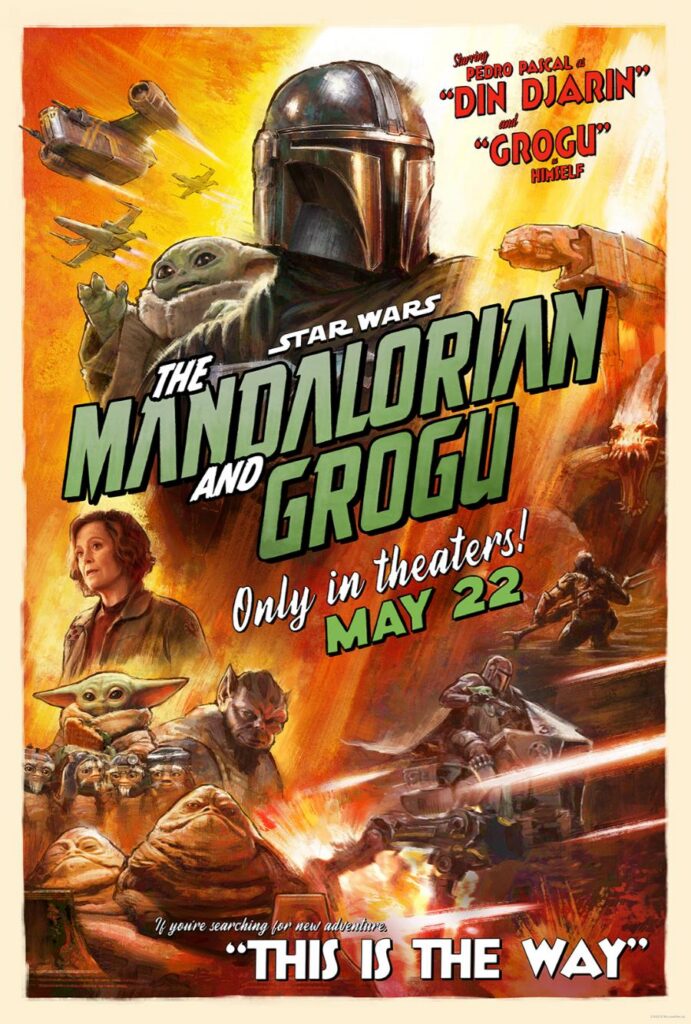
The advertising materials have a multitude of fonts and very busy graphic design, which serves as a harbinger of the film, which, in some ways, isvery simple and in others is all over the map. Technically, this is an impressive movie. It looks great. The music, score, unique planetary themes and the soundtrack are tremendous. The fights are precise, brutal, and largely brief. The evolving bond between Djarin and Grogu is vividly displayed in this picture, and by the end, Din is comfortable with Grogu’s growth. The action beats tend to repeat in style if not in substance, with a more truncated, “monster-of-the-week” vibe morphing into “monster-of-the-scene” pace for a portion of the picture.
This movie serves as an introduction of Din Djarin and Grogu to an audience that is either only vaguely or not at all familiar with the show that has been streaming on Disney + for three seasons since 2019. As characters, at the end, the Mandalorian and Grogu have achieved stasis again. It’s a good, fun, somewhat mindless, summer, popcorn-crunching flick. Also, there is a proper beginning, middle and end, but if a fan of the broadcast comes in with expectations, they need to know the overarching plot laid out by Favreau and Filoni during the run of the show, and the other Filoni-IPs doesn’t move forward.
Star Wars: The Mandalorian and Grogu is in theatres 05/22/2026.
The Star Wars Universe was created by George Lucas.
Din Djarin and Grogu were created by Jon Favreau.
Garazeb “Zeb” Orrelios and Embo the Kyuzo hunter were created by Dave Filoni.
 Anthony Andujar Jr.
  Newsdesk